Birding Montrose Point
A Guide to Birding Montrose Point in Chicago
Montrose Point is a mecca for birders and one of the most popular birding spots in Chicago. Over 350 species* have been recorded there over the years, including a staggering variety of rarities and vagrants, as well as several first state records for Illinois. Among these are Magnificent Frigatebird, Reddish Egret, Black Rail, Wandering Tattler, Ancient Murrelet, Ross's, Black-tailed, and Ivory Gulls, Royal and Sandwich Terns, Cassin's Kingbird, Rock Wren, Sage Thrasher, Grace's, Kirtland's, and Townsend's Warblers, and Painted Bunting.
Besides the unusual species, Montrose is an excellent place to observe migration, particularly the spring and fall passerine movement. What makes it so good? A combination of factors, including habitat diversity, location along a natural corridor for migrants, and the fact that Montrose Point protrudes well into Lake Michigan. These reasons are why Montrose is considered one of the best birding spots in Chicago. Additionally, the easy access, well-marked trails, and small size make it attractive to birders.
*Recent additions: Gull-billed Tern (June 1, 2023), Eastern Screech-Owl (August 8, 2023), Ferruginous Hawk (November 6, 2023)



Location and Description
Montrose Point is located within Lincoln Park on the north side of Chicago. The area covered by this guide is bounded by West Lawrence Avenue on the north, North Lake Shore Drive on the west, and Buena Avenue on the south. This includes Montrose Beach, Montrose Harbor, the small pond at the north end of the Sydney R. Marovitz Golf Course, and Cricket Hill. On a map Montrose Point looks like a curled arm bulging out into Lake Michigan. The link below opens an image that shows the boundaries of Montrose Point as defined in this guide.
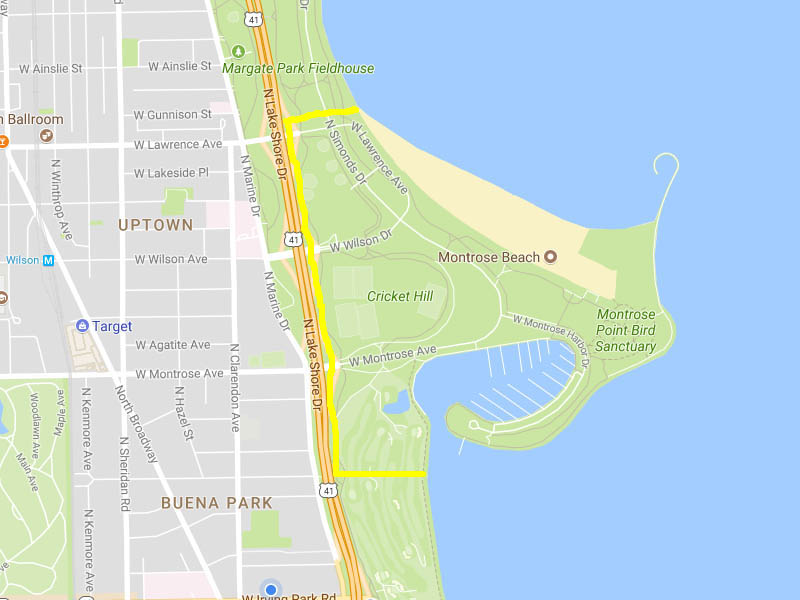
To reach the main birding areas at Montrose Point, take West Montrose Avenue (4400 North) east until you reach West Montrose Harbor Drive. Turn right (east) at West Montrose Harbor Drive and proceed about 1/5 of a mile. You can park along either side of the road. The best birding areas, including the Magic Hedge and Montrose Dunes, are to the east and northeast. A series of well-marked foot trails and paths wind through the area. The trails lead to the Magic Hedge, beach, Dunes, and other birding areas. You can walk any trail but don't enter areas that are roped or fenced off. Feel free to wander around and explore. This Google Map shows the road system in and around Montrose Point.
In terms of habitat, Montrose Point is open parkland, with scattered trees, copses, shrubs, hedgerows, and grassy fields. Montrose Dunes is a foredune habitat that developed in recent years due to the low level of Lake Michigan. The Dunes consist of a diverse community of beach loving plants, some of which are quite uncommon.
Montrose Point Bird Sanctuary
The Montrose Point Bird Sanctuary is a subarea of Montrose Point. It includes the Magic Hedge, Meadow, and peripheral plantings. See the Montrose Glossary for a description of these terms. Also see the aerial photo of Montrose Point below. This Google Map shows the location of the main entrance of the Sanctuary on West Montrose Harbor Drive.
Montrose Point Aerial*
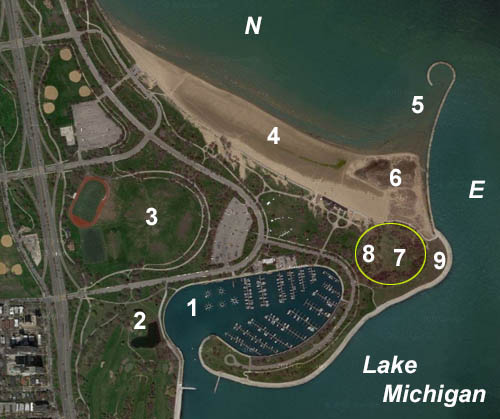
- 1) Montrose Harbor
- 2) Golf Course Pond
- 3) Cricket Hill
- 4) Montrose Beach
- 5) Fishing Pier
- 6) Montrose Dunes
- 7) The Meadow
- 8) Magic Hedge
- 9) Native Planting Area
Note: The yellow circle in the above map delineates the Montrose Point Bird Sanctuary.
*Courtesy of the United States Geologic Survey
What to See
-
 WaterfowlDucks, Geese, and Swans
-
 ShorebirdsSandpipers and Plovers
-
 Other WaterbirdsLoons, Grebes, Cormorants, Rails, Herons, Gulls, and Terns
 -
 Birds of PreyHawks and Owls
-
 LandbirdsSongbirds, Nightjars, and Cuckoos
-
 Other CrittersButterflies, Mammals, and Fish
Photos of Montrose Point
Click a thumbnail to see the larger version
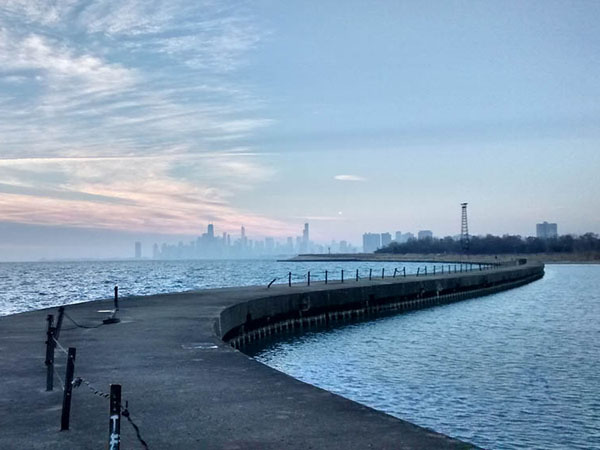
- Montrose Pier -
View looking south, with downtown Chicago and Montrose Point in the background.
Recent Developments
- In April of 2001, a major planting project began at Montrose Point. To protect the new trees and shrubs, a large part of Montrose Point, including the famous Magic Hedge, was fenced off. The fence was removed a few years later.
- In 2001 the entire eastern portion of Montrose Beach, including the nascent dunes, was fenced off as a protected nature area. Since then, the area is being restored to its natural state and exhibits much of the flora and fauna historical to our region.
- In 2008 the southeast corner of the Point was fenced off to protect the vegetation and discourage cruising. Access to this area is forbidden, and if you do enter you could be arrested. See the Montrose Frequently Asked Questions page for Montrose do's and don'ts.
- A number of car break-ins occurred at Montrose during the summer of 2011. If you drive to Montrose always remember to roll up your windows, lock your doors, and take your valuables with you.
- In 2013 the eastern panne in Montrose Dunes was cordoned off to protect the vegetation from trampling and disturbance. The western panne was cordoned off in 2014 for the same reason. Birders are asked to stay out of these areas.
- A butterfly garden was established in 2016 in the field northwest of the Magic Hedge. The garden hosts native wildflowers to attract butterflies. It can also be good for a variety of passerines, especially sparrows.
- In 2019, a pair of Piping Plovers named Monty and Rose nested and successfully raised young at Montrose Beach. This is the first time in over 50 years that Piping Plovers have nested in Chicago.
- Rising water levels on Lake Michigan have changed the shoreline dynamics at Montrose Point. The public portion of the beach is often flooded, reducing the amount of beach available to beachgoers, but creating habitat for gulls, terns, and shorebirds. Also, the winter of 2020 saw a couple of severe storms that flooded and damaged the Dunes, including the pannes. The effects of this damage will be long-lasting. A video of one of these storms is on The Montrose Birding Blog – January 11, 2020 Storm.
- On March 26, 2020, Chicago closed its lakefront parks to the public to limit the spread of COVID-19. The city reopened the lakefront trails on June 22, 2020. This includes the trails at Montrose Point. I wrote a blog post about the reopening – Montrose Is Open Again. Also see the Montrose Frequently Asked Questions page for updated information regarding parking and restroom availability.
- Our celebrity Piping Plovers Monty and Rose returned in 2020 and nested again. They successfully raised three young, and unlike last year’s brood, fish and wildlife officials banded all three. The young were also given names — Hazel, Esperanza, and Nish.
- After being closed for almost a year because of the COVID-19 pandemic, Chicago opened its lakefront parks in late February 2021. This includes Montrose Point and the Montrose Point Bird Sanctuary. See the Montrose Frequently Asked Questions page for updated information.
- Parking meters were installed at Montrose in May 2021. The meters are only along West Montrose Harbor Drive, so if you want to park on that road you'll have to feed a meter. Parking on West Montrose Avenue and North Simmonds Drive is free, at least for now. This Google Map shows the road system at and around Montrose Point.
- Construction of the paved, handicapped accessible path began in late June 2021. The path will allow people with mobility issues to more easily traverse the bird sanctuary. Construction of the path finished in August.
- Monty and Rose returned in 2021 and successfully raised two young, Imani and Siewka. This is the third year in a row they've returned to Montrose.
- Monty died unexpectedly in May 2022, thus ending the saga of Chicago’s first nesting Piping Plovers in over 50 years. Also, Rose did not return and is presumably no longer alive.
- Imani, the son of Monty and Rose from their 2021 brood, returned to Montrose Beach in 2022. He spent the better part of the summer in the Dunes, defending a territory and waiting for a female Piping Plover that never showed up.
- Imani came back in April 2023 for another attempt at passing on his genes.
Leslie Borns and Geoff Williamson made important contributions to this guide